
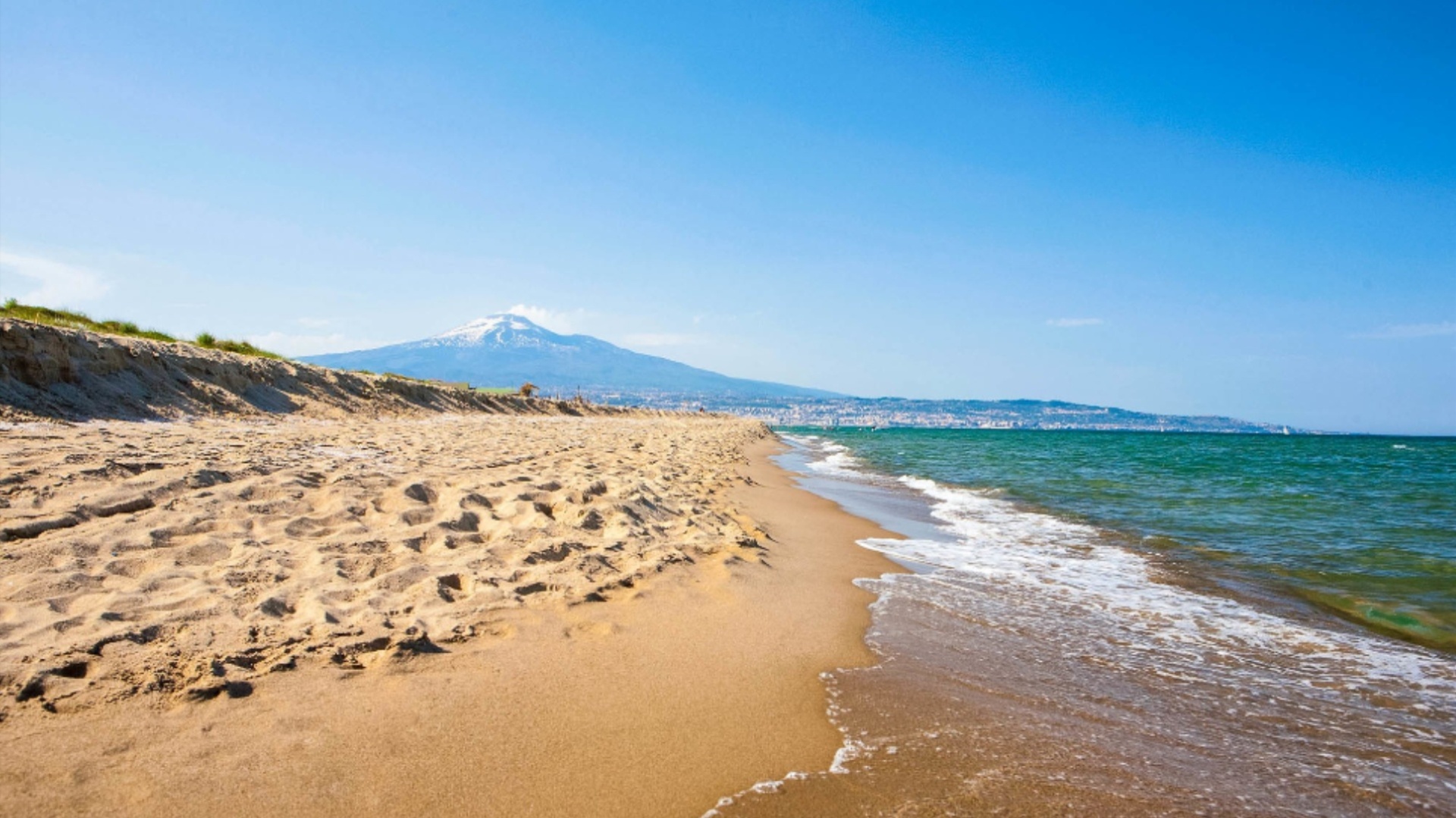
You are finally on holiday, and among the many reasons that led you to choose Sicily and the city of Catania is the wish to spend your days by the sea.
Did you know that the beauty of the Catania coast, in Eastern Sicily, lies precisely in its variety?
The coastline of the province of Catania offers golden sandy beaches, pebbles and stones, or volcanic sand, as well as basalt shores with unique features that make the Ionian coast around Etna a relative of Hawaii's.
Do you want to dive in where the water is bluest while staying close to Palazzo Speciale, or would you rather set off straight away in search of rare and unforgettable places?
We recommend four areas where you can soak up the sun and show everyone your swimming skills.
Follow our guide to the best beaches in Catania and you will plant your umbrella on the most beautiful stretches of coast in the province.
La Plaia
A long stretch of golden sand that takes in several seaside villages with equipped beach clubs, running from the southern outskirts of Catania all the way to Agnone Bagni, in the province of Syracuse.
From Palazzo Speciale you can easily reach the Plaia by city bus: in Piazza Borsellino, in fact, you will find the stop for line D, which will take you to Catania's best-loved beach.
Do you prefer a beach club (lido) with a bar, where you can rent an umbrella and sun loungers, or a free-entry facility?
The most famous beach clubs in Catania are La Cucaracha, Le Piramidi, Lido America, Le Capannine, Lido Belvedere, Aurora, Excelsior, Cled, Jolly, Internazionale, Venere and Lido Verde.
Bear in mind that at dusk many of them turn into real nightclubs.
Check Tripadvisor and, weighing up prices and services, choose the beach club that appeals to you most.
If you have children with you, the popular Lido Azzurro, Le Palme, Aurora and Arcobaleno offer a kids' club, entertainment and a family tutor service.
Affordable prices and cleanliness, a small bar, showers and changing rooms set Colonia Don Bosco apart. Highly recommended for families looking for peace and quiet, it does not rent out sun loungers or umbrellas, but it has a small pine wood where you can relax in the shade of the trees.
If, on the other hand, a free beach is what you are after, you can choose between three beaches run by the City of Catania: beaches number 1, 2 and 3. Be aware, however, that the public beaches are always very crowded and offer only a few basic services, such as lifeguards and showers. If you are lucky, at dawn you may spot the telline fishermen along these beaches: telline are small clams that live in the sand and that the people of Catania love. The fishermen still harvest them using the traditional method, with a sort of rake.
If you are in Catania on 1 May, two major music festivals with internationally renowned bands and DJs take place on the Plaia: One Day Music and Revolution Day.
Tired of being rocked by the waves? You can return to your comfortable room at Palazzo Speciale and carry on your evening in the city's alleys, enjoying local cuisine or an excellent aperitif.
Oasi del Simeto
If, as well as enjoying a day at the beach, you are also a keen birdwatcher, then your destination is the Simeto river mouth beach (Spiaggia foce Simeto).
The Simeto is Sicily's largest river in terms of flow and catchment area. The beach lies right inside the Oasi del Simeto nature reserve. Remember, however, that swimming is prohibited along one stretch of the area, so pay attention to the signs.
You can easily reach the oasis on AMT city bus no. 538, which leaves from Piazza Borsellino, just a few metres from Palazzo Speciale.
Given the wild nature of the place, sadly damaged beyond repair in some spots by past human development, we recommend bringing not only your swimsuit and a mask to look at the seabed, but also hiking shoes, spare socks and mosquito repellent.
Naturally, if you are a birdwatcher or a botanist, you will need clothing in colours that blend into the natural surroundings, photo and video equipment, binoculars, a notebook to record your discoveries, and field guides to the birds of Italy and the Mediterranean flora.
Once you reach the reserve, to get to the river beach simply follow the little road along the riverbanks.
The route has many surprises in store: the area is full of ponds much loved by birds such as flamingos, black-winged stilts, lapwings, short-eared owls, herons, cormorants, geese and storks.
This very special ecosystem is home to many plant species, and there is no shortage of amphibians and reptiles; among them, you might come across a native turtle, the Sicilian pond turtle. On the beach, meanwhile, you can have fun searching the shoreline for amber: the amber found at the mouth of the Simeto is known as simetite and is highly prized.
La Scogliera
Have you ever tried diving off a basalt cliff, or sunbathing on a volcanic sand beach?
Here too, from Piazza Europa through Ognina and on to Aci Castello, the coast offers surprises, relaxation and fun.
Remember, however, that in some parts of the area, especially near boat landing points, swimming is prohibited, so always pay attention to the signs.
Along the rocky coast of the Catania seafront there are many private beach clubs with plenty of facilities: sun terraces, swimming pools, hot tubs, entertainment, wi-fi, diving, restaurant-bars, and tennis and beach volleyball courts. These include Cocoa Beach and Bikini Beach Café.
If you don't need any comforts, just find a way down to the water's edge and spread your towel on whichever lava rock inspires you most for its shape and closeness to the sea.
Further on you will reach San Giovanni Li Cuti, an old fishing village and, like the Plaia, one of Catania's favourite seaside spots.
The village takes its name from a church, perhaps no longer standing, dedicated to Saint John (San Giovanni), and from a feature of the coast: its rocks. In Catania dialect, rocks and lava pebbles are called "li cuti" or "li cutilisci", which can be translated as "smooth rocks".
San Giovanni Li Cuti, in fact, lies in an area formed by the historic lava flows of 1169, 1329 and 1381.
Have you ever sunbathed on a beach as black as a starless night? At San Giovanni Li Cuti, besides the rocks and pebbles, you can stretch out on volcanic sand.
This beach also has a small walkway run by the city, with a ladder giving disabled visitors access to the sea.
As well as enjoying the beach and the waves, we recommend a stroll around the picturesque village, whose little harbour is home to the gozzo, the traditional wooden fishing boat.
If you want to head further north, after San Giovanni Li Cuti you will come to the village of Ognina.
In Piazza Nettuno, the City of Catania has built a sun terrace, also with sea access for disabled visitors and a lifeguard service.
The sun terrace is a wooden walkway built over the rocks, with ladders to make it easier to get into the water.
Ognina is full of restaurants and beach clubs, and here too there is a small marina with specialist services for pleasure boats: Porto Ulisse, famous for appearing in the film Divorce Italian Style (Divorzio all'italiana), starring the great Marcello Mastroianni.
Porto Ulisse is what remains of an ancient landing place where the Lognina or Ognina river once flowed into the sea, buried, like the whole area, by the lava flow of 1381.
Aci Trezza
A swim in Aci Trezza means immersing yourself in Sicilian folklore, Greek myths and the great classics of literature. Lively in the evening with restaurants, bars and pubs, by day it is a place to visit for its natural beauty and its sea.
To get there, take AMT bus line 534 from Piazza Borsellino. This old fishing village, now a popular tourist and holiday destination, is the heart of the Riviera dei Ciclopi (Cyclops Riviera).
The name is easily explained: Homer's Cyclopes roamed these lands and feature in many myths. One of them explains the origin of the sea stacks that rise from the water and, together with the island of Lachea, form this small archipelago: according to Homer's myth, they are the rocks that Polyphemus hurled at Ulysses' ship as the cunning king of Ithaca made his escape. In reality, science confirms that these unique formations, known as columnar basalts, are volcanic in origin, created by underwater eruptions.
Another very important geological phenomenon you can observe here, so rare that it links these shores to those of Iceland, New Zealand and, with some differences, Hawaii, is pillow lava: roughly spherical rocks that can be seen at the old port of Aci Trezza.
To reach the island of Lachea and its sea stacks, including the largest, known as La Madonnina for the statue of the Virgin Mary on its top, head to the small harbour.
There are no bars on the island, so remember to bring water and food with you.
At the harbour you can also watch the shipwrights of the Cantiere Rodolico boatyard building the typical fishing boats, the gozzi.
And a rowing gozzo will be your taxi, taking you from the inner docks of the harbour to the rocky shore of the island for just €3 return; once on board, tell the boatman whether you prefer the side facing the village or the hidden side of the island, which is much quieter and wilder.
The island's rocks are a paradise for divers, while its seabed is a joy for snorkellers: bring a mask, snorkel and fins to discover the wonders of the sea, but only look, because fishing is banned here, as you are in a strict nature reserve.
The reserve is managed by Cutgana, a body that is part of the University of Catania.
If you want to explore the island of Lachea itself which, small as it is, holds great surprises, such as being the only habitat of an endemic species, the red-necked lizard, you can book a guided tour.
Cutgana offers the service free of charge, but you need to book by emailing visite.cutgana@unict.it or by calling 095 6139260 or +39 340 8280281.
Tours start from the little red house clearly visible on the island of Lachea; for the excursion, wear sportswear, a hat and hiking or non-slip boots.
And how do you get back to the village? To secure your return trip, just go down to the water's edge and whistle to the wooden boats offering the shuttle service, constantly going back and forth between Aci Trezza and the island.
The setting and the boat trip will have reminded you of Giovanni Verga's novel I Malavoglia (The House by the Medlar Tree) or Luchino Visconti's film La terra trema (The Earth Trembles), which was inspired by Verga's work. The reason is simple: Aci Trezza is where both masterpieces are set. Some of the people who appeared in Visconti's film, such as Agnese Giammona, who played Lucia, are still alive and occasionally give interviews to film students and journalists.
If you want to immerse yourself even further in Verga's world, once back on dry land head to the Casa del Nespolo Museum.
The museum is in Via Dietro Chiesa and is open from 9:30 am to 12:30 pm and from 4:00 pm to 6:00 pm. The 19th-century building gives you an idea of what the homes of Aci Trezza's fishermen were like in the last century. The exhibition is dedicated to Visconti's film, with material from the shoot, letters and photographs by Giovanni Verga, and objects that take us back to the fishing techniques, customs and traditions of the 19th century.
The Casa del Nespolo Museum also holds a rich photographic collection dedicated to the popular festival U pisci a mari (the fish in the sea).
This event, dating back to the 18th century, takes place on 24 June in the stretch of water in front of the harbour, during the celebrations for the town's patron saint, John the Baptist, and accompanies the religious festivities.
It is a very important popular event: a pantomime that, recalling ancient propitiatory rites, stages a mock capture of a swordfish.
Book your stay
Check live availability and rates. Booking directly is always the best deal.
Check availability