
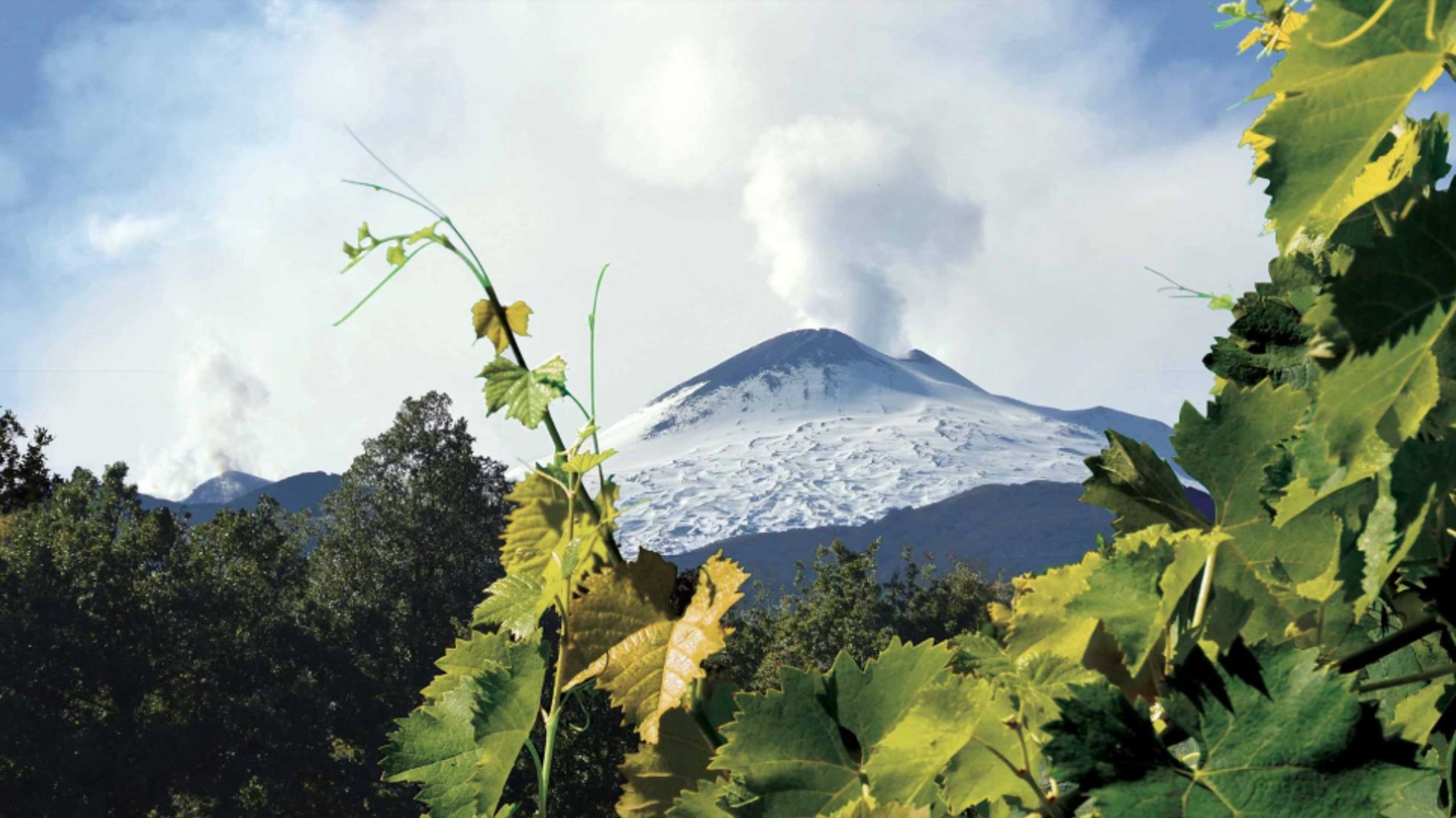
A land shaped by eruptions and lava, a climate that knows neither half measures nor restraint, a place where Nature can be both a generous mother and a ruthless tyrant. Ready to explore the slopes of Etna, the highest active volcano in Europe, and discover Etna wines? At these altitudes, defying the centuries, the eruptions and the harshness of the environment, ancient vineyards with gnarled vines, heavy with grapes of bold, austere flavour, rise from the ground and from the terraces that tame the steep slopes.
After introducing the different types of Etna DOC wine, we recommend two areas, the North-East slope and the South-East slope, depending on whether you want to raise a glass of Etna red or Etna white.
Etna wines: which DOC types should you taste?
It seems these lands knew the secrets and pleasures of the vine as far back as ancient times. What is certain is that Etna wine is Sicily's oldest DOC and one of the first to be regulated in Italy.
For your information, the DOC production area defined by the official regulations covers 20 municipalities in the province of Catania: Biancavilla, Santa Maria di Licodia, Paternò, Belpasso, Nicolosi, Pedara, Trecastagni, Viagrande, Aci Sant'Antonio, Acireale, Santa Venerina, Giarre, Mascali, Zafferana, Milo, Sant'Alfio, Piedimonte, Linguaglossa, Castiglione and Randazzo.
So which DOC wines will you enjoy tasting? Etna Rosso, Etna Rosso Riserva, Etna Bianco, Etna Bianco Superiore, Etna Rosato and Etna Spumante.
- Etna Rosso, with a beautiful ruby colour and an intense bouquet, is made from two native grapes: Nerello Mascalese (at least 80%) and Nerello Cappuccio (up to 20%), with other permitted varieties allowed up to 10%. It is full-bodied and dry, perfect with meats and medium-aged cheeses.
- Etna Rosso Riserva is a fine wine made from the same grapes as Etna Rosso but aged for at least 4 years.
- Etna Bianco, straw yellow with a delicate bouquet, is made from Carricante (at least 60%) and Catarratto (up to 40%), or with other white varieties permitted by the regulations (usually Minnella Bianca, Trebbiano or international varieties, up to 15%). It is dry and well balanced.
- Etna Bianco Superiore, produced only in the municipality of Milo, ages better than other whites; it must be made from at least 80% Carricante, with up to 20% of other permitted white varieties. It is dry and smooth.
- Etna Rosato, with an intense bouquet and a dry yet balanced taste, is made by fermenting red grapes (Nerello Mascalese and Nerello Cappuccio) as a rosé, by fermenting a blend of red and white grapes, or from a blend of red and white musts.
- Etna Spumante can be made as a rosé or as a white, with secondary fermentation in the bottle for at least 18 months; its bouquet is intense and its taste full and balanced.
North-East slope: the great reds
The Etna Wine Route (Strada del Vino dell'Etna) is above all the route of the great reds.
Their excellence comes from exceptional soil and climate conditions, marked by the minerality of the volcanic soil and the superb exposure of the terraces.
To discover both the beauty of Etna and the local wineries where you can taste the real thing, you can set off on the Wine Train (Treno dei Vini), a journey that combines the pleasures of taste with a touch of history: you will ride a historic train from Riposto to Piedimonte Etneo, and from there to Randazzo.
From Randazzo, the Wine Bus will take you along the Etna Wine Route to two outstanding wineries, with guided visits and tastings.
The two wineries you visit will be chosen from those in the circuit: Scilio, Vivera, Cantine Russo, Cottanera, Firriato, Palmento Costanzo, Tasca d'Almerita, Tornatore, Tenuta di Fessina, Fischetti, Antichi Vinai, Al-Cantàra, Destro, Terrazze dell'Etna, Cantine Madaudo and La Gelsomina.
The tour runs twice a week, every Thursday and Saturday; to check available dates and book the Wine Train with online tickets, visit www.stradadelvinodelletna.it/biglietti-online.
Remember that booking is mandatory and must be made by 12:00 noon the day before the tour. Lunch is not included, so bring your own or, during the 12:30 break in the historic village of Castiglione di Sicilia or Randazzo, ask your guide to recommend a good place to eat. Just don't linger over lunch, because the tasting journey resumes at 3:00 pm.
To reach Riposto, where the Circumetnea railcar departs, you can take a regional train from Catania station. Check the timetable on www.trenitalia.com, selecting "Catania Centrale" as your departure station and "Giarre-Riposto" as your destination.
As you will have gathered, you will need an early start: leave Palazzo Speciale at least 20 minutes before your train to Riposto departs.
The Wine Train leaves the Circumetnea station in Riposto at 9:15 am.
South-East slope: the finest whites
This area, and the municipality of Milo in particular, is known for producing Etna Bianco DOC, a one-of-a-kind wine whose excellent organoleptic qualities also make it suitable for ageing.
These qualities come both from the soil and climate of this part of Etna and from the strong winds blowing in from the sea, which keep the grapes well ventilated, protecting them from mould, and bring minerality, which in turn gives the wine of this area a slightly savoury note.
To visit this slope, too, we recommend hiring a car so you can drive from Catania to an outstanding estate such as Terre di Costantino.
Terre di Costantino is in Viagrande, at Via Garibaldi 417, in Contrada Blandano, an area long devoted to winemaking.
The estate offers two tours: Getting to Know the Winery (Conoscere la cantina) and Lunch in the Winery (Pranzo in cantina).
The Getting to Know the Winery tour offers an overview of the vineyard, about 10 hectares of volcanic soil, the winery and the historic palmento, the traditional stone wine press house.
At 500 metres above sea level you will feel the breeze drifting among the native vines of Nerello Mascalese, Nerello Cappuccio, Carricante, Catarratto and Minnella.
The 90-minute visit includes lessons on traditional winemaking and on Etna's stratigraphy through sections of the soil. The tasting includes three wines, bread baked in a wood-fired oven and organic extra virgin olive oil.
Lunch in the Winery lasts two and a half hours: in addition to the Getting to Know the Winery tour, it includes lessons on modern winemaking and a visit to the root cave. The tasting features four wines, wood-fired bread, organic extra virgin olive oil and platters of local cheeses and cured meats.
To book a visit to Terre di Costantino, call 095 434288 or write to info@terredicostantino.it.
Book your stay
Check live availability and rates. Booking directly is always the best deal.
Check availability