Although the celebrations for Saint Agatha take up a good part of January, the high point of the Feast of Saint Agatha is undoubtedly 3, 4 and 5 February. The whole city comes to a standstill and pours into the streets of Catania day and night, bringing to life one of the most important religious festivals in the world, in which faith and folklore are inseparably intertwined.
The religious celebrations begin on 3 February with the evocative procession of the offering of wax to the Saint. It sets off from the Church of Sant'Agata alla Fornace in Piazza Stesicoro, built over the ancient furnace where the Saint was martyred, and makes its way to the Cathedral in Piazza Duomo. The procession is led by the 11 candelore, or "cannalori": tall wooden columns, richly carved and decorated, holding large candles and representing the city's ancient arts and crafts guilds.
Because of their considerable weight, the candelore are carried on the shoulders of 4 to 12 men, the bearers, who move them forward with a characteristic swaying gait called "'a 'nnacata". The procession is followed by all the city's civil and religious authorities. The "Senate Carriage" sets off from Palazzo degli Elefanti, the town hall: it is in fact two 18th-century carriages that belonged to the city's ancient Senate, in which the mayor and some councillors travel to the Church of San Biagio to hand the keys of the city to the religious authorities. The first day ends in the evening, "'a sira 'o tri", in a packed Piazza Duomo, with a concert of songs dedicated to the Saint and a grand, unique fireworks display in which the fireworks follow the rhythm of the music.
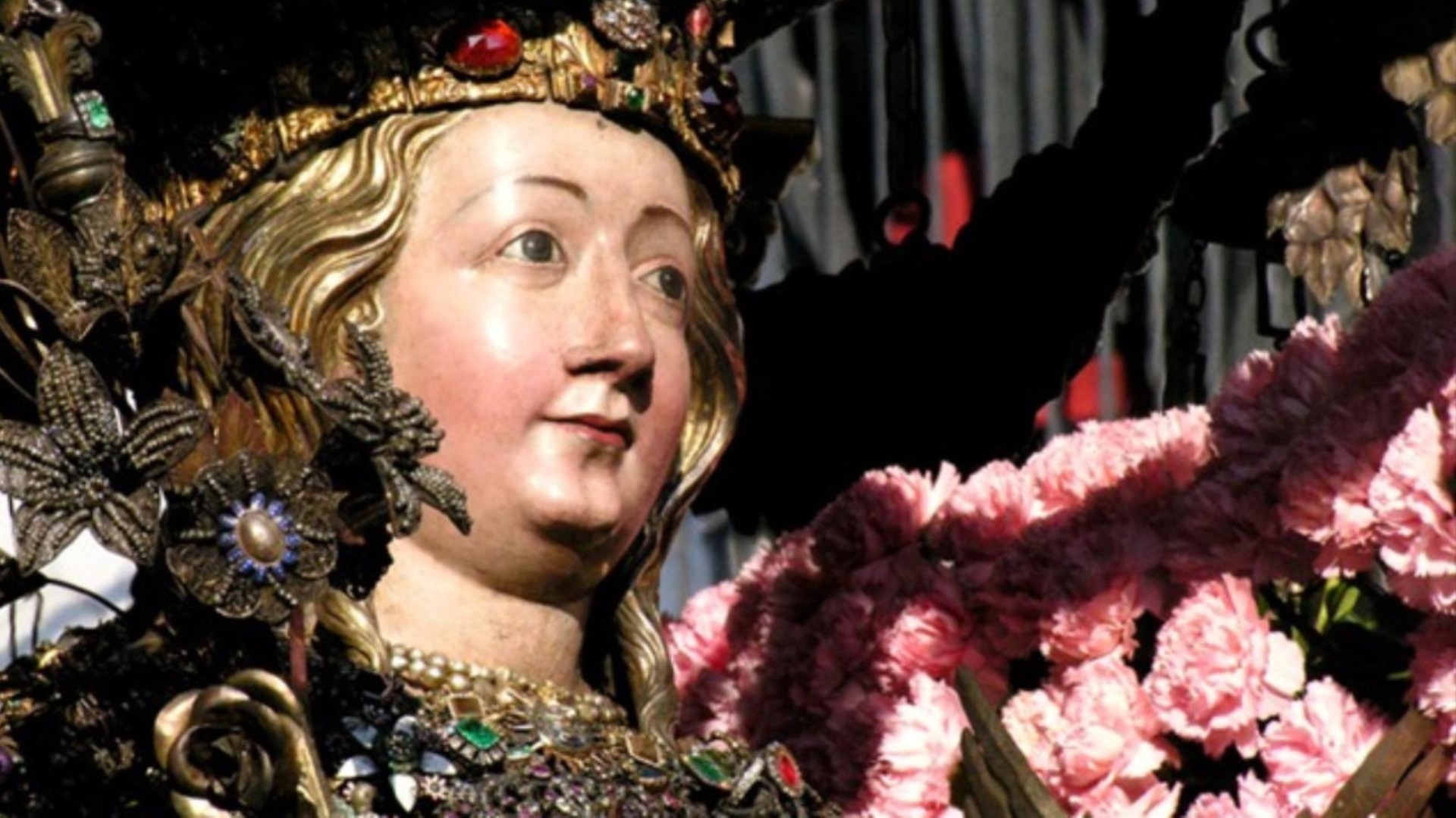
The celebrations continue on 4 February with a religious service, the "dawn mass", in the Cathedral in Piazza Duomo. Before the service, the reliquary bust of Saint Agatha is brought out of the small chamber where it is kept. Three keys, held by three different people, are needed to open the heavy gate of the chamber. This is the moment when the people of Catania meet their "Santuzza" again after a year. The cry of the devotees greeting her is moving and unstoppable: a call to all the citizens present to venerate her, as they wave white handkerchiefs.
«è ccu razia e ccu cori,
pi sant'Aituzza bedda, ca stà niscennu,
cittadini!
semu tutti devoti, tutti?
cittadini, cittadini,
cittadini!
evviva sant'Agata,
cittatini!
evviva sant'Agata.
tutti devoti, tutti?
cittadini, cittadini!»
The precious half-bust containing Agatha's relics is placed on the ferculum, "'a vara", and carried to the high altar, and the service begins. Straight after mass, the ferculum, also carrying the silver casket with the Saint's relics, is taken out in procession. This is the start of the "outer tour" of the city, a long procession that ends at first light on the 5th and passes through the places of the martyrdom and the places linked to the "Santuzza". The most evocative and spectacular moment of this second day is undoubtedly "'a cchianata de' Cappuccini", when the devotees pull the ferculum at a run to the top of the climb known as the Cappuccini, arriving in front of the Church of San Domenico.
Another important stage of this tour is "'a calata da marina", the ancient descent towards the sea which, until the end of the 19th century, reached the spot where the Arches of the Marina now stand. This is the symbolic place from which the Saint's relics left for Constantinople. The procession of the 4th ends at first light when, back in the Cathedral, the Saint is greeted by a spectacular fireworks display.
A short break and a little rest before the city fills up again with faithful and devotees in their white robes (the "sacco") for the last, very long day of the feast.
It is 5 February, Saint Agatha's Day.
In the late morning the solemn pontifical mass is celebrated in the Cathedral, in the presence of bishops from all over Sicily and a papal legate. The ferculum, covered the day before with red carnations symbolising martyrdom, is now covered with white carnations, a symbol of Agatha's purity. After sunset, at around 6 pm, the "inner tour" of the city begins. The ferculum climbs Via Etnea, reaching Piazza Cavour late at night. Better known as the "Borgo", this is the district where refugees from Misterbianco were taken in after the eruption of 1669.
Here the Saint stops for another eagerly awaited fireworks display, after which the procession continues back down Via Etnea to what is surely the most spectacular moment of the whole feast: "'a cchianata 'i Sangiulianu". Between two walls of breathless onlookers, the devotees run the ferculum up the steep climb of Via San Giuliano. It is a very dangerous stretch, which leads to a stop in the city's most beautiful Baroque street, Via Crociferi, where, in front of the convent of the Benedictine nuns, the silent crowd listens to the nuns singing hymns to Saint Agatha from behind the monastery's grilles.
It is an evocative and mystical moment for everyone taking part. This is the last stop before the return to the Cathedral, which for some years now has taken place in broad daylight. One more great fireworks display, the last one. After three long days in the hands of her citizens, the Saint bids farewell to her city and returns to her small chamber.
Book your stay
Check live availability and rates. Booking directly is always the best deal.
Check availability