
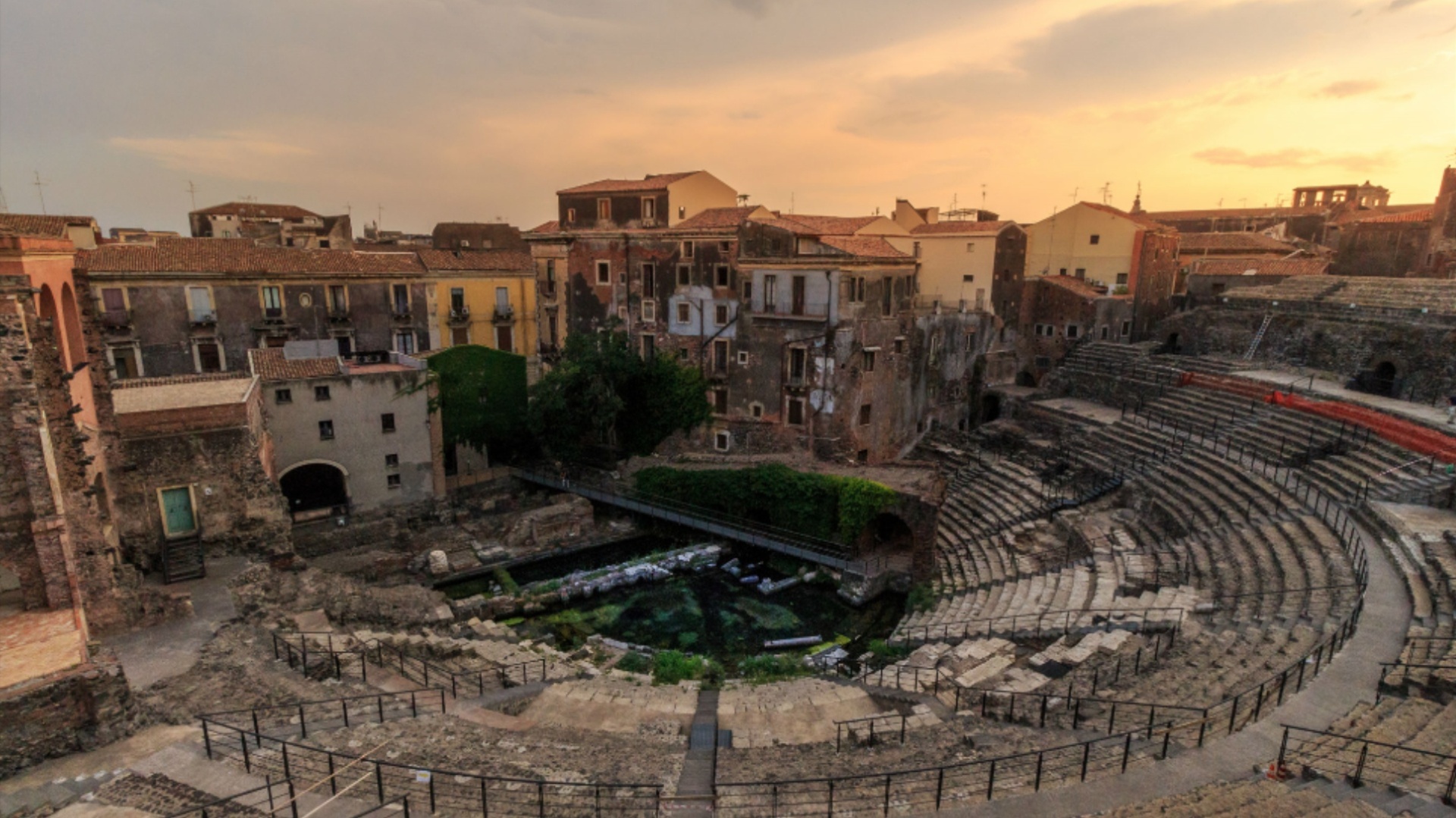
Catania reveals, through its monuments and archaeological excavations, all the rulers and peoples who have crossed and inhabited it, enriching it with traditions and monuments.
Among the peoples who fell in love with this area and its landscape, stretching from the Ionian Sea to Etna, were the Romans.
Clearly visible traces of the monumental ruins of the Roman era still remain, having survived the centuries and the eruptions: sometimes embedded in the lava rock, incorporated into modern buildings or trapped in private alleys and courtyards, or still unexplored beneath today's city.
Ready for a trip back in time? In this guide, we will take you around Catania in search of the traces of the glorious Roman civilisation.
Historical background
 Before starting our tour and stepping into the shoes of skilled urban archaeologists, it is worth knowing a little history.
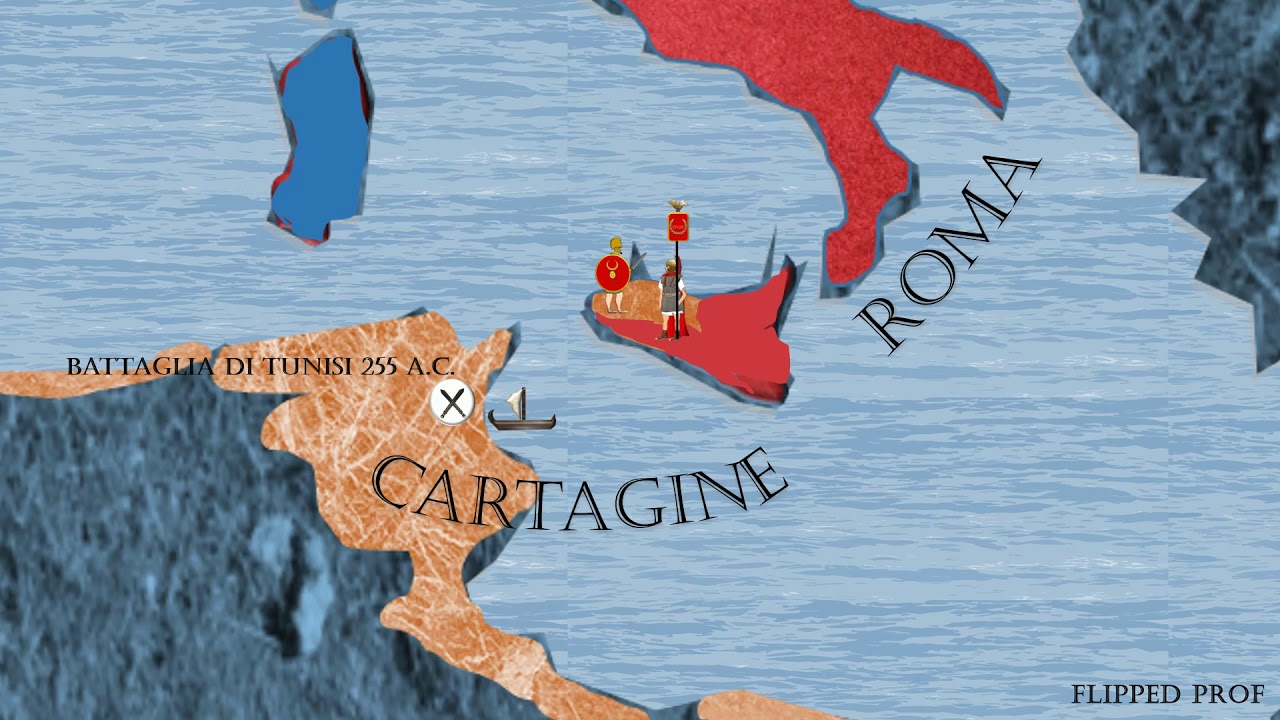
The Romans conquered Catania in 263 BC, at the very beginning of the First Punic War.
The protagonist of this epic undertaking was the consul Manius Valerius Maximus Messalla.
Around 135 BC, Catania was the scene of revolts during the First Servile War and, in 35 BC, of the revolt led by the gladiator Selurus.
From 122 BC onwards the territory was severely damaged by Etna's volcanic activity, including the disastrous lava flow of 32 BC.
The decline caused by natural disasters was compounded by the conflict between Octavian and Sextus Pompey, which devastated Sicily.
From 21 BC, when Augustus raised it to the rank of colony, the city began its economic recovery.
Although, given the city's importance and strategic position, Christianity may well have spread here very early, historical research confirms the presence of Christian communities in Catania from the 3rd century.
Evidence includes the martyrdom of Saint Agatha, the city's patron saint, during the persecution of Decius (250–251), and the martyrdom of Saint Euplius during the persecutions of Diocletian (303–304).
In addition, a 3rd–4th century inscription records a "martyrium with a small early Christian triconch basilica".
As for the bishopric, reliable records only date from between the 4th and 6th centuries; tradition, however, names Berillus of Antioch as the first bishop, sent by the Apostle Peter to evangelise Catania in AD 42.
Roman rule ended in AD 440, when the Vandal king Genseric conquered the island.
A Roman city rich in water
The street plan of Roman Catania was laid out on two perpendicular axes, the cardo and the decumanus, around which the public buildings stood.
The Amenano river, now underground, flowed through the city, and an aqueduct built by the Romans carried water from a distant spring.
The city was therefore rich in water and bath complexes.
The Terme dell'Indirizzo
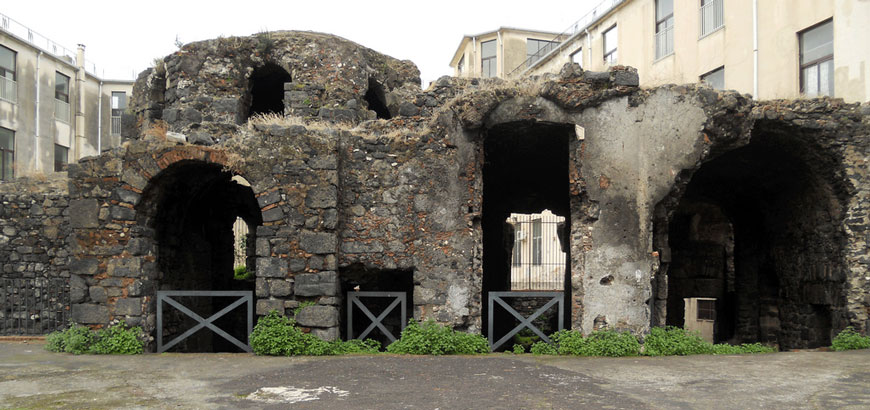 To find the traces of a bath complex, head from Palazzo Speciale towards Piazza Currò to admire what remains of the Terme dell'Indirizzo, part of the Greek-Roman Archaeological Park of Catania.
Admission to the site is free, but visits are by reservation only.
To book, write to poloregionalect.urp@regione.sicilia.it or call
095 7150508.
The baths take their name from the nearby Church of the Madonna dell'Indirizzo.
Of the original complex, ten rooms remain today, with their barrel, cross and domed vaults almost intact; among them, the octagonal room that served as a calidarium is particularly interesting.
The Terme dell'Indirizzo bath complex was fed by the Amenano river.
Continue along our route to find the ancient and seemingly vanished river.
A few metres from where we are, next to the steps leading down to the Pescheria fish market, lies the south side of Piazza Duomo, and right here you can admire the Amenano Fountain, brought to life by the legendary waters you set out to find.
The Carrara marble statue by Tito Angelini represents the River: a young man holding a cornucopia.
Take a coin, make a wish to travel back in time to the Roman era and, with your eyes closed, toss it into the fountain, entrusting your dreams to the Amenano as it flows beneath the city.
The Achillean Baths
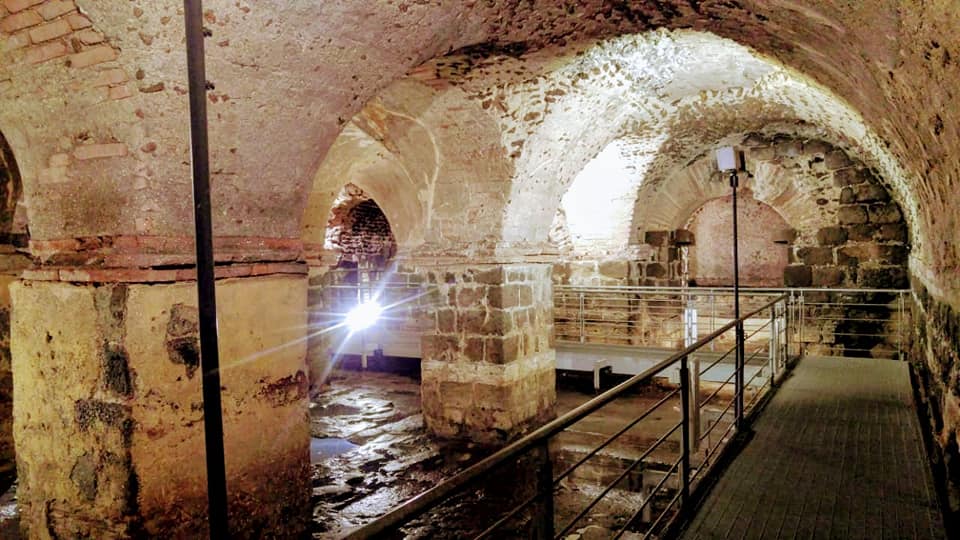 After this propitiatory ritual, as magical as it is romantic, you are truly ready to begin the tour suggested by Palazzo Speciale and dive into the past by visiting the Achillean Baths, which extend beneath the Cathedral; their true extent is still unknown, as only a small part of the original complex can be visited.
Built around the 3rd or 4th century, the site owes its name to a 5th-century AD inscription (kept in the Castello Ursino Civic Museum) and to the 8th-century records of Bishop Saint Leo; the name "Achilliane" may come from the builder's name or from a lost statue of the Homeric hero.
If the baths can be visited today, after being buried by the well-known natural disasters of the 17th century, we owe it above all to the Prince of Biscari, Ignazio Paternò Castello, who cleared them of debris in the 18th century.
The site is now managed by the Diocesan Museum.
So head towards the Cathedral: the ticket office is at Via Etnea 8.
Visits take place Monday to Friday from 9:00 am to 2:00 pm and on Saturdays from 9:00 am to 1:00 pm; on Tuesdays and Thursdays the site is also open in the afternoon from 3:00 pm to 6:00 pm. On Sundays and public holidays, visits are by reservation only and for groups of at least 20 people.
Keep in mind that last admission to the Diocesan Museum is half an hour before closing.
A ticket for the baths only costs €5; however, we recommend buying the Cataniapass, a tourist card that gives access to the municipal museums, the Diocesan Museum and the Achillean Baths, as well as urban public transport, including the Alibus and the metro.
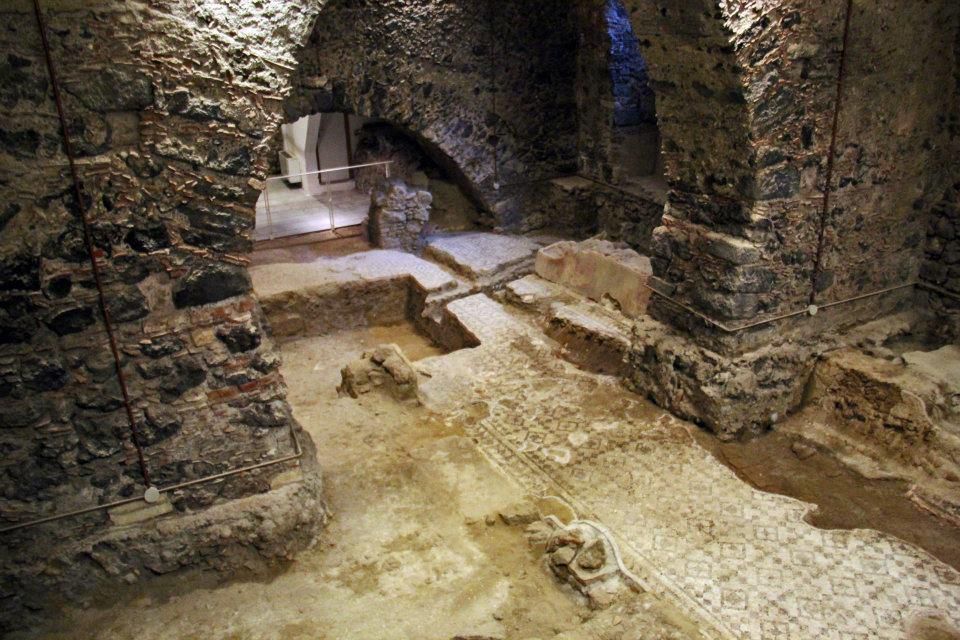
The Achillean Baths are entered through a corridor covered by a barrel vault in cement mortar, supported by walls of lava stone blocks topped with a double row of bricks.
Other rooms once opened off this corridor, including the tepidarium, of which the curved hall and the channel system can still be seen today.
The corridor leads to the central hall, which can be visited: a rectangular room with four pillars supporting the vaults, decorated with stucco depicting vine shoots and bunches of grapes. In the centre of the "pillared hall" is the basin, originally faced with marble, as was the floor of the hall, probably in opus sectile.
Sant'Agata Cathedral
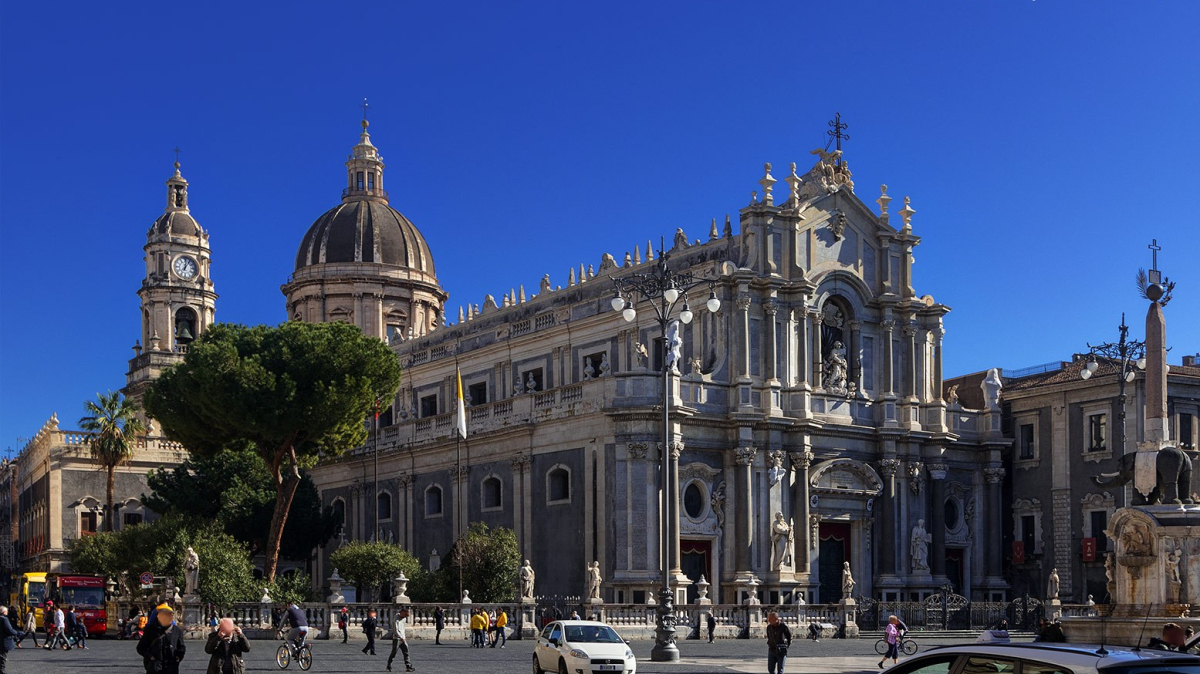 For now, stay in
Piazza Duomo and head towards Sant'Agata Cathedral; on its façade you can see columns probably taken from Catania's Roman Theatre.
Now step inside to admire its treasures of sacred art; along the right aisle is the Chapel of Saint Agatha, which houses the bust and the reliquary casket containing the relics of the holy virgin, patron saint of Catania, martyred under the Roman Emperor Decius (AD 249–251) at the hands of the cruel proconsul Quintianus.
Roman floor at Palazzo Biscari
Near Piazza Duomo, in Via Museo Biscari, stands Palazzo Biscari, still partly lived in by the noble Moncada Paternò Castello family.
The sumptuous palace can be visited every day, but it is always best to book by calling 095 7152508. Tickets cost about €10.
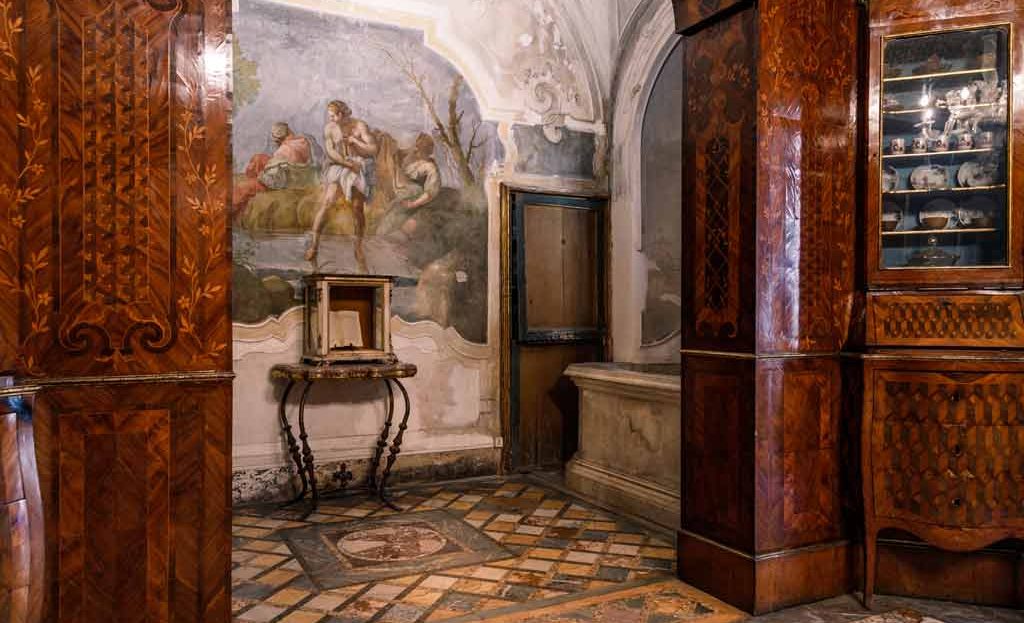 Beyond the decorations and the architectural and artistic wonders, remember that you are about to walk on a genuine Roman floor of coloured marble, which Ignazio Paternò Castello, 5th Prince of Biscari and a passionate collector of antiquities, found in the 18th century and used to decorate the "princess's apartments".
Catania's necropolis
Palazzo Biscari is wonderful, isn't it? We think so too. Now make your way back to Via Etnea and follow it to Villa Bellini; here, turn into Viale Regina Margherita and follow it to number 35, where the 19th-century Villa Modica stands, with a Roman patrician tomb in its garden.
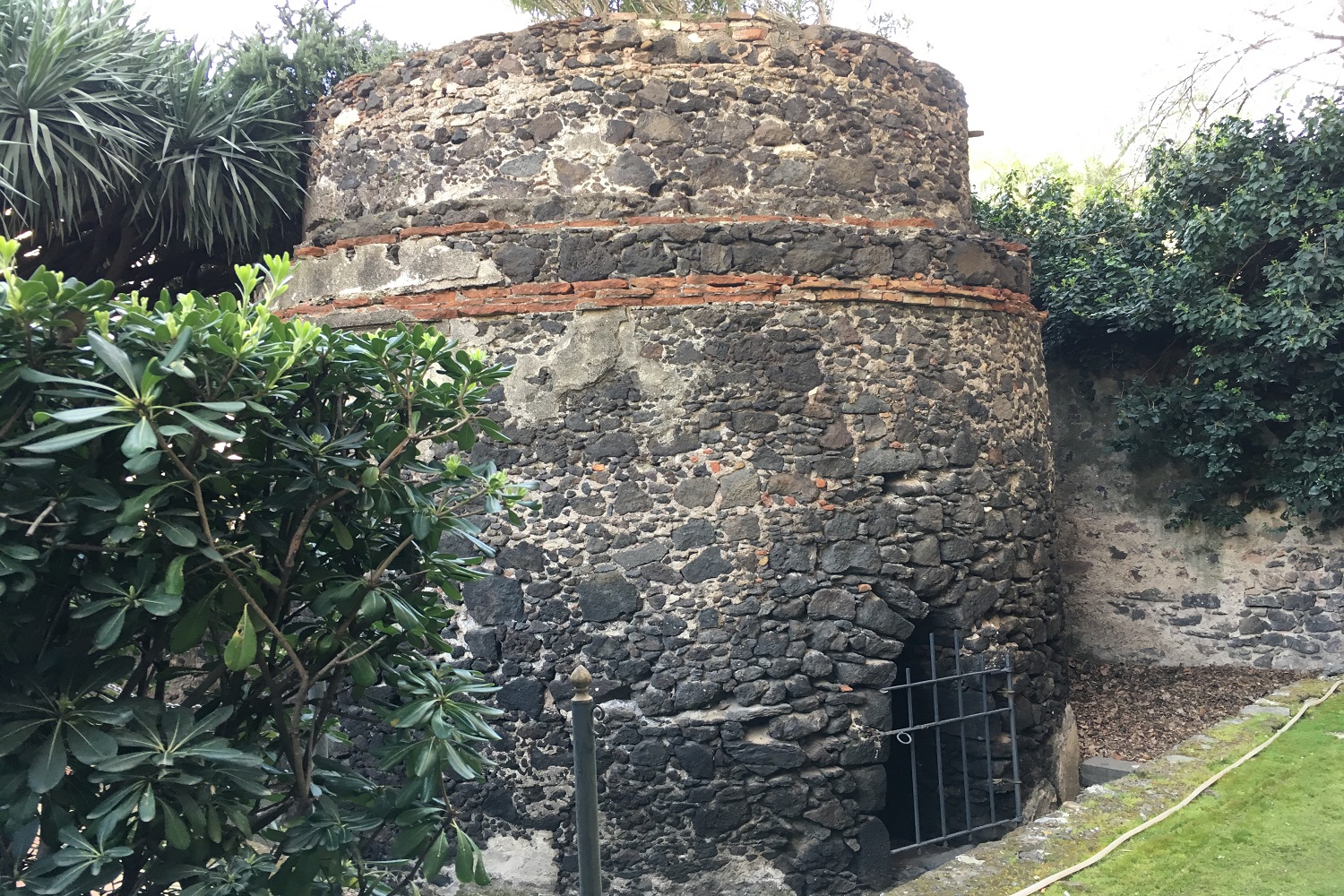 The mausoleum, circular in plan and almost 8 metres in diameter, is entered through an arched opening, beyond which you can admire the walls carved with niches. The area is private, but the owners allow visits by prior arrangement.
If you can't visit the circular mausoleum, don't worry: a few metres away is a square hypogeum, whose large rectangular structure you can admire.
Admission is free, but by reservation only; to book, write to poloregionalect.urp@regione.sicilia.it or call 095 7150508.
"The eastern half of the building consists of a massive structure, while the opposite half is occupied by a square room, originally vaulted, reached by a staircase." A rectangular burial niche opens in the back wall, while four more niches are set into the other walls.
After visiting the square hypogeum, continue towards Piazza Santa Maria di Gesù to admire an early Christian tomb in the Church of Santa Maria della Mecca, now known as the Chapel of the Garibaldi Hospital; this small church, in fact, stands in the courtyard of Catania's Giuseppe Garibaldi hospital.
At the end of the visit, retrace your steps along Viale Regina Margherita until you reach Via Sant'Euplio, where the ruins of a church dedicated to the city's co-patron saint stand.
The church was destroyed in an air raid in 1943, but a small staircase leads down to an underground chamber carved into the rock, with side niches, where, according to legend, the saint was captured before his martyrdom.
This site is often closed, but you can book a visit through the association
Etna 'ngeniousa by calling 338 1441760 or emailing asso.etnangeniousa@gmail.com.
 After this visit, head towards Piazza Carlo Alberto, where in one of the inner courtyards of the former Carmelite convent, now the Army Documentation Centre, you can partly glimpse another Roman tomb; built of lava stone blocks, it is said to have been Saint Agatha's first burial place, although some have identified it as the tomb of the poet Stesichorus.
Also in Piazza Carlo Alberto, if you are lucky enough to find it open, you can visit the Church of San Gaetano alle Grotte, which houses a 3rd-century AD Roman crypt.
The Roman Amphitheatre
Once you have finished exploring the Roman necropolis, continue along Via Etnea to Piazza Stesicoro, where you will find the Amphitheatre of Catania, the largest and most complex Roman amphitheatre in Sicily.
Looking at the site from the square, the large inscription "Per me civitas catanensium sublimatur a Christo", a phrase attributed to Saint Agatha, immediately catches the eye.
Built around the 2nd century, from the Middle Ages onwards it was used as a quarry for building materials; it was buried by the earthquake of 1693 and finally brought back to light in the early 20th century.
The amphitheatre is open Tuesday to Saturday, morning and afternoon; to enter, simply pass between the Doric and Ionic columns that frame the metal gate, beneath the lintel bearing the inscription "Amphitheatrum insigne", as if to welcome you.
More discoveries among the alleys
After your visit, you will probably be asking yourself three questions: why is there an inscription with a phrase attributed to Saint Agatha on the walls of the amphitheatre? How tall was the Amphitheatre? And how far did it extend?
To answer the first question, you only need to visit two churches: San Biagio and Sant'Agata al Carcere. The reason is simple: the saint's martyrdom took place in this very part of Catania.
The Church of San Biagio, in fact, stands in Piazza Stesicoro, right opposite the Amphitheatre, and is also known as Sant'Agata alla Fornace; according to tradition, this is where the furnace used to torture the city's co-patron saint to death once stood, and its remains are kept in a reliquary above the altar.
The Acts of the martyrdom tell not only that Agatha was subjected to ever crueller torments until her death on 5 February AD 251, but also that after each new torture she was locked up in prison.
The prison where the young Roman virgin was confined and where she died is just a few metres away: today's Church of Sant'Agata al Carcere. To get there, take Via Cappuccini, to the right of the Church of San Biagio, keep to the left-hand side and you will reach your destination, Piazza Santo Carcere.
Inside the church, to the right of the presbytery, is the small door leading to what tradition identifies as Saint Agatha's Prison; on the right wall of the presbytery, again according to tradition, you can see the saint's footprints imprinted on the lava stone slabs.
Now it is time to find out how tall and how large the Roman Amphitheatre was. To answer your questions, leave the church and take the little downhill street in front of you, Via del Colosseo, which leads to Via Manzoni.
Once there, turn right and you will immediately see a sign for Vico Anfiteatro; inside, three large arches support the wall of Villa Cerami's hanging garden and give you an idea of the Amphitheatre's height.
 Head back along Via Manzoni, take Via Penninello and follow it up to the steps leading to Via Crociferi; here it is worth stopping to visit the Monastery of the Benedictine Nuns, where you can admire the remains of a Roman domus.
Three rooms can be made out among the remains: a courtyard paved with basalt slabs, a pantry with the remains of a washbasin, and a space facing Via Crociferi.
After visiting the Monastery of the Benedictine Nuns, turn from Via Crociferi into Via Cerami, home to the Faculty of Law at Villa Cerami.
Right here, inside Villa Cerami, part of the system of arches that connected the Amphitheatre to the hill shows you just how far the Amphitheatre extended.
Roman prison
Now, from the Faculty of Law, head to Via San Giuliano; here, next to the Church of the Minoritelli and right opposite the Santa Marta hospital, you can see the remains of a Roman prison through which, according to tradition, Saints Alfio, Filadelfo and Cirino passed before their martyrdom.
Balneum of Piazza Dante, Benedictine Monastery
Keep walking up Via San Giuliano until you reach Piazza Dante, home to the former Benedictine Monastery, now the seat of the university's Faculty of Letters and Philosophy.
In front of the monastery, behind an iron fence, you can see the remains of a small bath complex, more precisely the balneum of a domus.
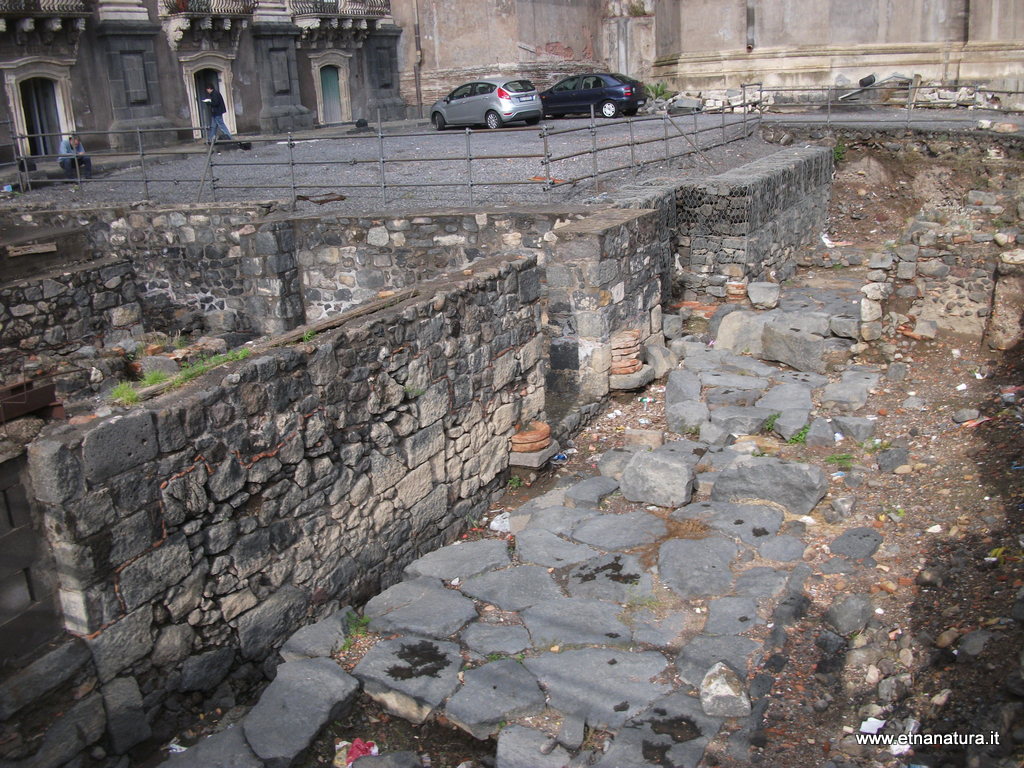 Once through the entrance into the university courtyard, you can see a stretch of Roman road, the cardo.
The monastery is a jewel of magnificence that hides many wonders; inside, in the university's periodicals library, you can admire the mosaics of a Roman domus.
To visit the monastery, you can join the guided tour run by the association Officine Culturali, which takes place every day from 9:00 am to 5:00 pm and costs about €8.
Terme della Rotonda
After visiting the former Benedictine Monastery, walk along Via dei Gesuiti until you reach Via Marino on your right, which will take you to our destination in Via della Mecca: the monumental Rotonda complex.
This site is also free to enter but open by reservation only; to book, write to poloregionalect.urp@regione.sicilia.it or call 095 7150508.
In this area, which already bore traces of the Copper Age and the Greek period, a Roman bath complex was built in the 1st or 2nd century AD; it remained in use until the 6th century and then became a church, probably of Byzantine origin.
The bath complex consists of nine rooms, once paved with mosaic or marble and with frescoed walls, arranged to the south and east of the large circular hall known as the "Rotonda", which, given its many pools, seems to have been a calidarium or a nymphaeum.
North of the Rotonda lies a large cistern which, connected to the ancient aqueduct, fed the bath complex and is linked to the Rotonda by a square room.
Antiquarium, Roman Theatre, Odeon
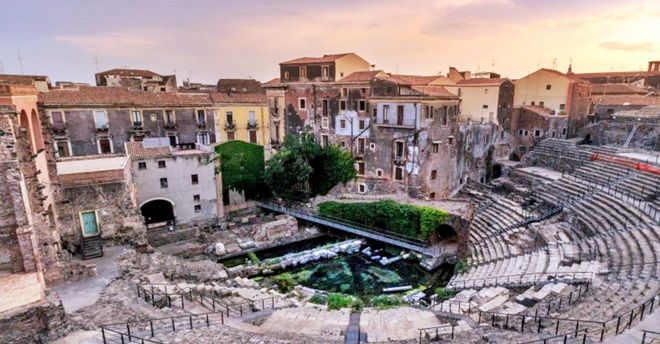 Now make your way to the Ancient Theatre of Catania. The site is entered from Via Vittorio Emanuele 266; occasionally, there is access from another entrance at Via Teatro Greco 47.
Remember that the site is open from 9:00 am to 7:00 pm; if you have decided not to buy the Cataniapass, a single ticket costs between €3 and €6.
Before entering the theatre, be sure to visit Casa Pandolfo and Casa Liberti, now home to the regional Antiquarium of the Roman theatre, where some important archaeological finds from the city are on display.
The Roman Theatre dates back to the 2nd century and was built on top of a Greek theatre; today the orchestra, the cavea and parts of the stage building are still visible. As you will see once inside, the cavea is only partly preserved, as the upper tiers have been lost.
To the west of the theatre stands the Odeon, a small theatre also dating from around the 2nd century, whose cavea is thought to have held 1,500 spectators; the building's monolithic look, due to the lava stone, was probably offset by marble decoration, as the orchestra also shows.
Roman Forum and Balneum of Piazza Sant'Antonio
Near the Roman theatre, from Via Vittorio Emanuele take Via Politi and then turn into Via Orfanelli, the street leading to the Cortile di San Pantaleone, where you can see the remains of the Roman Forum: a couple of rooms and a wall in opus reticulatum.
According to tradition, the Roman Forum of Catania is where Saint Euplius, the city's co-patron saint, was martyred.
From the Cortile di San Pantaleone, take Via SS. Trinità to Via Sapuppo, then turn into Piazza Sant'Antonio; in this square is a balneum whose frigidarium you could glimpse, were it not for an iron and glass structure protecting the ruins that prevents visits.
Castello Ursino and Piazza Mazzini
Now all that is left is to visit the Castello Ursino Civic Museum. From Piazza Sant'Antonio walk along Via Sapuppo, then turn right into Via Santa Maria dell'Aiuto
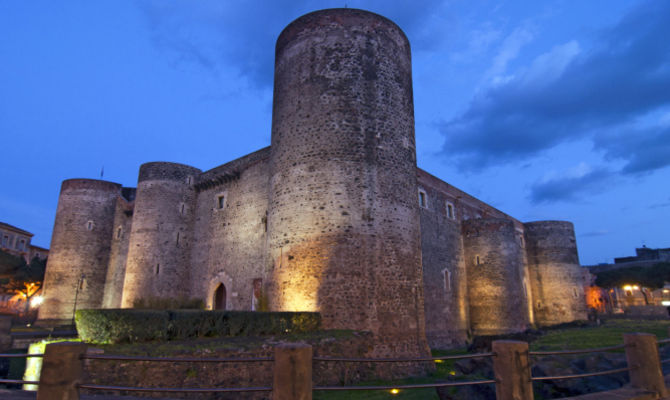
until you reach Via Naumachia on your left; from here, turn first into Via Santa Chiara, then into Via Riccardo da Lentini until you reach Via Castello Ursino; follow this street to Piazza Federico di Svevia, where Frederick II's Castello Ursino stands, home to the Museum.
The castle, which is worth a visit for its history even without the museum collections, is open every day from 9:00 am to 6:00 pm. The Museum's collections are many and vast; among its many exhibits and works of art is a large collection of archaeological finds from the Hellenistic and Roman periods.
 After your visit to Castello Ursino, go back to Piazza Federico di Svevia, take Via Auteri and follow it until you meet Via Giuseppe Garibaldi on your left, then continue to Piazza Mazzini where, among the arcades, you can see eight Roman columns, perhaps once part of a basilica that has since disappeared.
The Amenano Grotto
Having explored the Roman remains in Catania's historic centre, you will have realised that many remains of the ancient city are still hidden beneath the streets today.
But it is now time for dinner, and perhaps it would be fitting to finish where you began this tour: the Amenano river.
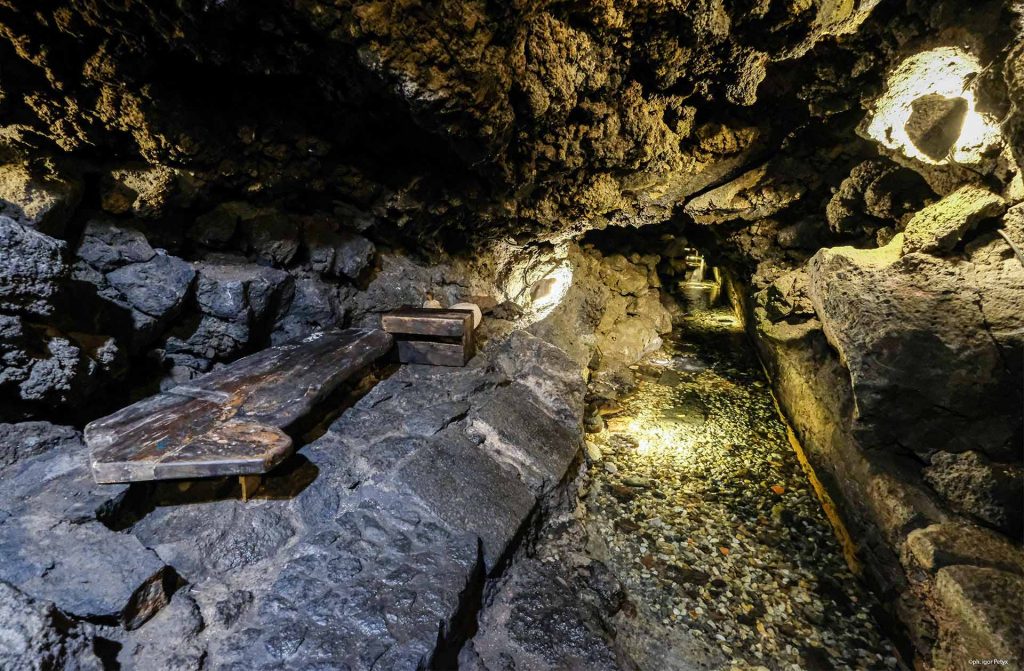 And here you are at your last stop: A putia dell'Ostello in Piazza Currò, where you can treat yourself to the flavours of Sicilian cuisine in a lava cave crossed by the waters of the legendary river.
To be sure of a table right on the banks of the Amenano, book on +39 095 723 3010.
Remember
Useful numbers for booking the visits recommended in this guide:
- Terme dell'Indirizzo, Square Hypogeum, Monumental Rotonda Complex
Tel: 095 7150508.
e-mail: poloregionalect.urp@regione.sicilia.it
- Palazzo Biscari
Tel: 095 7152508
- Benedictine Monastery, tours by the Officine Culturali association
Tel: 095 7102767 | 334 9242464
e-mail: info@officineculturali.net
- Crypt of Sant'Euplio, tours by the Etna 'ngeniousa association
Tel: 338.1441760
e-mail: asso.etnangeniousa@gmail.com
- A putia dell’Ostello
Tel: +39 095 723 3010.
Book your stay
Check live availability and rates. Booking directly is always the best deal.
Check availability